

DME & Wound Care AI
Automated coverage determination, wound care documentation, and interoperable workflows — built on deterministic systems that are auditable, reproducible, and ready for production. Patient and provider centric.
DME suppliers and wound care providers are buried in paperwork, denials, and disconnected systems. The cost isn’t just operational — it’s patient care delayed.
Clinicians spend 12+ hours per week on wound care paperwork. Each wound requires separate measurements, staging, tissue type, and exudate documentation — often for multiple wounds per patient. Since CMN retirement in 2023, the same data must be extracted from unstructured clinical records.
Advanced wound care claims face 30-35% denial rates nationally. NPWT carries a 17% improper payment rate. SMRC is actively auditing surgical dressings. UPIC audits use statistical extrapolation — a single audit can generate millions in recoupment demands.
70% of DME orders still arrive by fax. EHRs, wound care software, DME supplier systems, and payer portals don't talk to each other. Critical wound data is trapped in unstructured notes, requiring manual extraction at every handoff.
There is a better way.
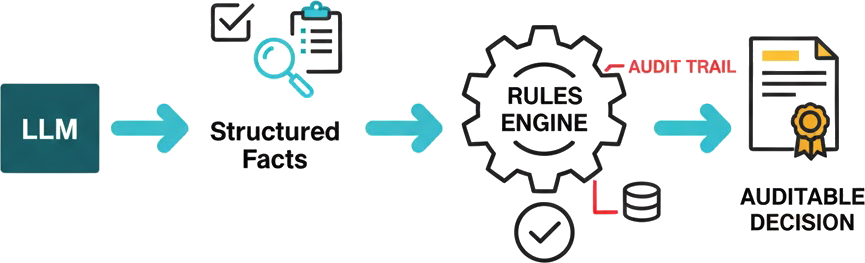
AI extracts. Rules decide. Every determination is auditable.
Wound care clinical notes, progress reports, photos, physician orders
Extract wound measurements, tissue type, staging, treatment history, HCPCS-relevant details"
Typed wound assessment objects: L x W x D, % granulation/slough/eschar, exudate type and amount, Bates-Jensen scores
CMS LCD criteria (L33831 surgical dressings, L33821 NPWT, L33830 support surfaces), modifier logic (A1-A9, KX), quantity limits
COVERED: Alginate dressing (A6196) for 3.2 x 2.1cm full-thickness wound with moderate exudate. Evidence: Chart p.4, LCD L33831 criteria 4.2
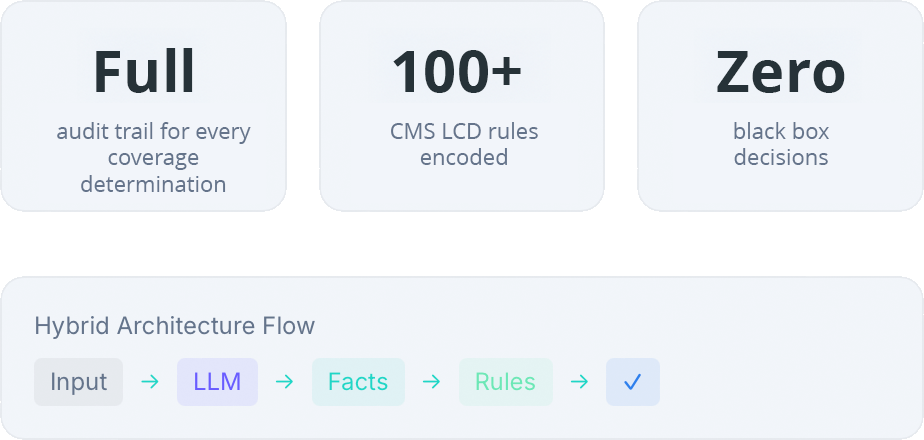
The LLM never makes the decision. It extracts structured facts from unstructured clinical text. The rules engine — deterministic, auditable, reproducible — applies CMS LCD criteria to those facts. Every coverage decision traces back to a specific rule, a specific quote from the chart, and a specific page number.

Every decision traceable to source quote and LCD rule

Same clinical note = same coverage decision, every time

Clear reasoning chain from wound data to coverage outcome

Rules engine encodes LCD criteria, not LLM guesswork
End-to-end AI solutions for DME workflow, wound care documentation, and healthcare interoperability.
Automated coverage decisions for regulated DME environments.
Deterministic decision systems built on CMS guidelines.
AI extraction of structured wound data from clinical notes.
Connect EHRs, DME suppliers, and payers with structured data.
Real systems solving real problems in DME and wound care.
Clinical NLP Stack
Automate Medicare coverage determination for wound care DME from unstructured clinical documentation while maintaining full compliance with CMS LCD guidelines.
LLM extracts wound characteristics — measurements, tissue type, staging, exudate, treatment history — from clinical notes. A deterministic rules engine applies CMS LCD criteria including L33831 (surgical dressings), L33821 (NPWT), and L33830 (support surfaces) to the structured facts.
“Every coverage decision traces back to a specific LCD rule, a specific quote from the chart, and a specific page number.”
DME Workflow Automation
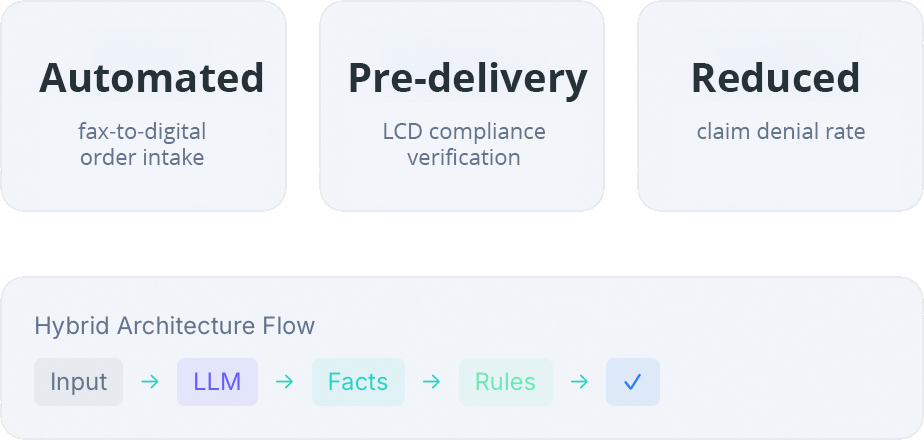
Streamline the DME order-to-delivery workflow — from faxed referral intake through eligibility verification, prior authorization, documentation assembly, and claim submission.
AI-powered intake digitizes faxed orders, extracts patient and clinical data, and routes through automated eligibility and compliance checks. Rules engine validates LCD coverage criteria before delivery, preventing downstream denials.
“Orders that used to take days of manual processing now flow through in hours — with better compliance than we achieved manually.”
Interoperable Wound Care Records
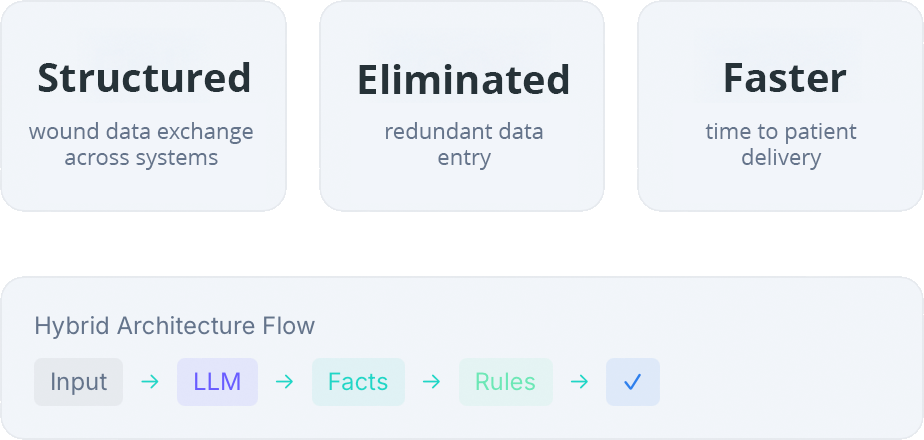
Connect wound care assessments across EHRs, specialty wound care systems, DME supplier platforms, and payer portals — eliminating the manual re-entry and fax-based handoffs that delay patient care.
FHIR-based integration layer extracts structured wound data from clinical systems and delivers it to DME suppliers and payers in the format each system requires. AI fills gaps where structured data isn’t available by extracting from unstructured notes.
“For the first time, wound care data flows from the clinician to the DME supplier to the payer without anyone re-typing it.”
Ready to implement AI that actually works? Tell us about your project.
Last updated: February 2026
PaxMed AI provides artificial intelligence consulting services, including but not limited to AI strategy, implementation, and integration services. All services are provided on a project basis under separate written agreements.
All content on this website, including text, graphics, logos, and software, is the property of PaxMed AI and is protected by intellectual property laws. You may not reproduce, distribute, or create derivative works without our express written permission.
This website is provided “as is” without warranties of any kind. PaxMed AI shall not be liable for any indirect, incidental, or consequential damages arising from your use of this website. Our liability for any direct damages shall not exceed the amount paid by you, if any, for accessing this website.
Consulting engagements are governed by separate Master Service Agreements and Statements of Work. The terms on this website do not supersede or modify any executed client agreements.
These terms shall be governed by and construed in accordance with the laws of the State of Delaware, without regard to conflict of law principles.
We reserve the right to modify these terms at any time. Continued use of the website after changes constitutes acceptance of the modified terms.
For questions about these Terms of Service, contact us at info@PaxMed.ai
Last updated: February 2026
When you use our contact form, we collect the information you provide, including your name, email address, company name, and message content. We do not use cookies for tracking or advertising purposes.
We use the information you provide solely to respond to your inquiries and to communicate with you about our services. We do not sell, rent, or share your personal information with third parties for marketing purposes.
Your information is stored securely using Google Firebase infrastructure, which employs industry-standard security measures including encryption in transit and at rest. We retain your information only as long as necessary to fulfill the purposes outlined in this policy.
You have the right to request access to, correction of, or deletion of your personal information. To exercise these rights, please contact us at the email address below.
If you have questions about this Privacy Policy, please contact us at info@paxmed.ai